


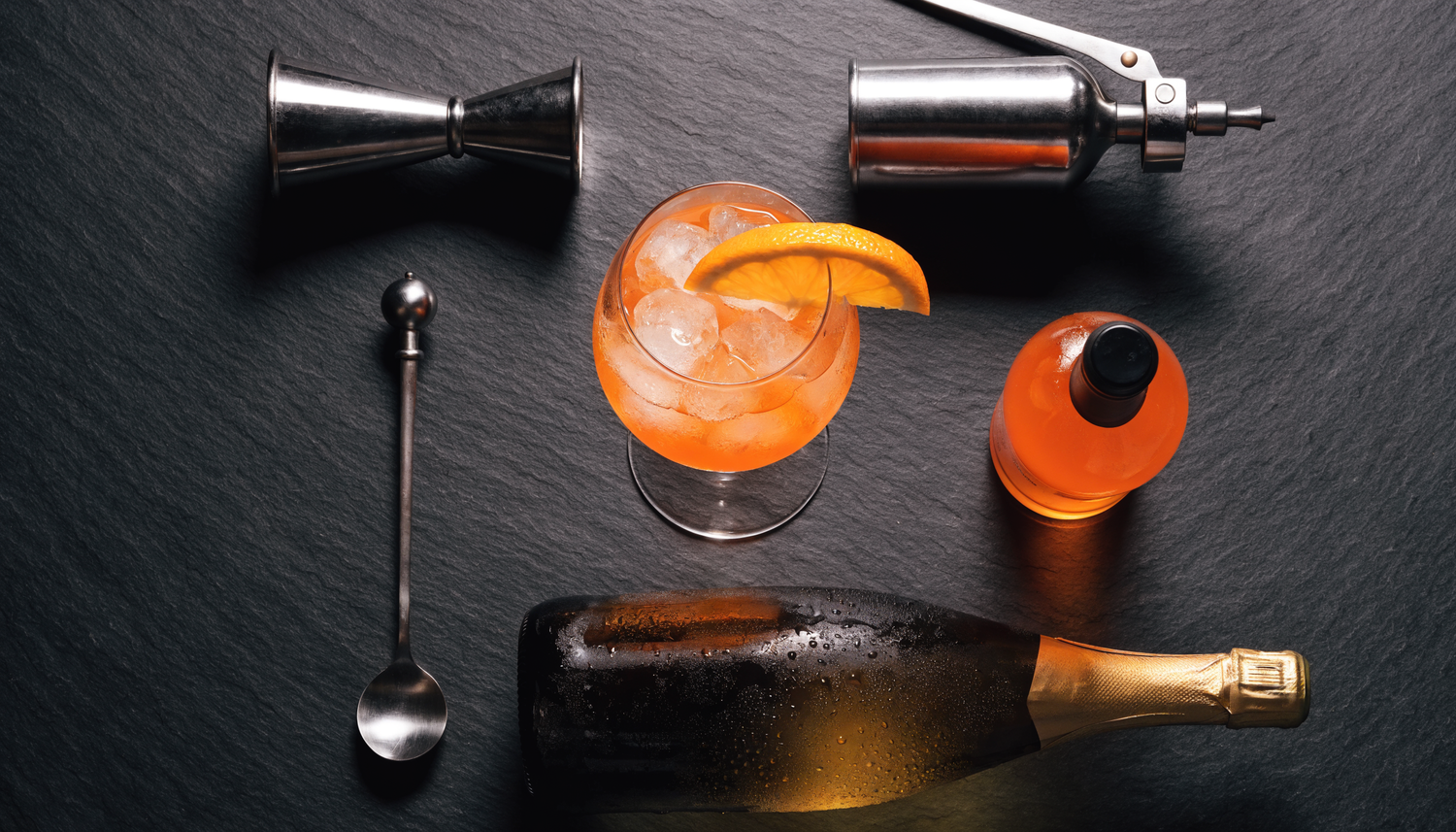
Almost every cocktail recipe you find online is really a ratio. Not “6 cl of this and 9 cl of that,” but two parts to three parts. Once you understand that logic, you never need to look up a recipe again — and you can effortlessly scale any cocktail from one glass to a pitcher for eight.

A jigger and a little arithmetic replace a stack of recipes.
The four ratios you need: spritz is 3-2-1 (bubbles, bitter, soda). Sour is 2-1-1 (spirit, acidity, sweetness). Gin and tonic is 1-to-3 to 1-to-4. Negroni is 1-1-1. That covers the vast majority of all classics.
Why cocktails are written in parts
A cocktail is a balance of spirit, acidity, sweetness, and dilution. Once you express that balance in parts rather than centiliters, it becomes transferable: it no longer matters whether you use a small or large glass, and you can double it without doing any calculations.
That is also why bartenders think in parts rather than milliliters. An Aperol Spritz for one glass and a pitcher for eight guests follow exactly the same ratio; only the unit of measurement changes. And if a drink doesn't taste right, you immediately know which variable to adjust — more acidity, less sweetness, or simply more ice.
How many cl is one part?
A part is not a fixed measure, but in practice most recipes use 1.5 to 3 cl per part. A shot in the Netherlands is 3.5 cl, which often roughly corresponds to “one part of spirit” in a sour. A standard jigger has two sides: usually 3 and 4.5 cl, or 2 and 4 cl.
If you don't have a jigger, use an egg cup (approximately 4 cl) or a measuring cup. Above all, don't pour by eye: with spirits, a 1 cl discrepancy already amounts to a twenty percent difference in alcohol, and you taste that immediately.
The spritz family: the 3-2-1 ratio

The ratio for an Aperol Spritz
The ratio for an Aperol Spritz is 3-2-1: three parts prosecco, two parts Aperol, and one part soda. Specifically, that is 9 cl prosecco, 6 cl Aperol, and 3 cl soda water, poured over plenty of ice in a large stemmed glass. Pour in that order — prosecco first, then Aperol — because this keeps the bitter element from settling as a layer at the bottom and naturally creates the right color gradient.
The 3-2-1 ratio is not an arbitrary choice. The prosecco provides volume and bubbles, the Aperol bitterness and color, and the soda cuts through the sweetness. If you use equal parts prosecco and Aperol, the drink becomes heavy and syrupy. Leave out the soda, and the spritz lacks length. If you find it too sweet, first increase the prosecco to four parts before adjusting the Aperol — that way, you preserve the color. The full recipe is on our Aperol Spritz page.
Limoncello Spritz, Hugo and the rest of the family
The ratio for a Limoncello Spritz is the same 3-2-1, but you replace the Aperol with limoncello. Because limoncello is considerably sweeter and stronger than Aperol, many people prefer a 3-1.5-1.5 ratio: slightly less liqueur and slightly more soda. The same principle applies to the Hugo Spritz with elderflower syrup, but there you use one part syrup, because syrup is pure sugar.
The rule behind the family: the sweeter or stronger the flavoring ingredient, the smaller its share. Find recipes for the entire spritz family on the Limoncello Spritz page and among all cocktail recipes.
The gin and tonic: why your ratio depends on your tonic
For a gin and tonic, the ratio is 1 part gin to 3 to 4 parts tonic. In centiliters: 5 cl gin with 15 to 20 cl tonic. That may seem like a wide range, and it is—but here, the tonic determines what works best.
A neutral, dry tonic works perfectly well at a 1-to-3 ratio. A bold, sweet tonic with lots of botanicals overwhelms the gin at that ratio, so you should use 1-to-2.5 instead. Conversely, a robust navy-strength gin at 57 percent calls for more tonic, not less. Always taste a sip before garnishing; you can still adjust it at that point.
Two things are more important than the exact ratio. First: fill the glass completely with ice, not halfway. More ice melts more slowly and therefore dilutes the drink less. Second: use a spacious glass. In a 60 cl balloon glass, the botanicals can spread out; in a narrow glass, you will not smell any of them. For that, take a look at the gin and tonic glasses or the highball glasses.
The sour family: 2-1-1 and when to deviate

The sour is the best-known ratio in the cocktail world: two parts spirit, one part sour and one part sweet. For a Whiskey Sour, that means 4.5 cl whisky, 2 cl fresh lemon juice and 2 cl sugar syrup. The same 2-1-1 ratio applies to the Daiquiri (rum, lime, syrup), the Margarita (tequila, lime, triple sec) and the Pisco Sour.
You adjust based on the sweetness of your spirit. With an Amaretto Sour, the base is already sweet, so the ratio shifts toward more acidity: 4.5 cl amaretto, 2 cl lemon juice and just a bar spoon of syrup, plus 1.5 cl bourbon to balance the sweetness. With a Margarita made with a good reposado, you can use slightly less triple sec.
If you add egg white or aquafaba for a foamy head, the ratio does not change—only the technique. First shake for ten seconds without ice, then for fifteen seconds with ice, and double-strain.
The strong classics: Negroni, Old Fashioned, and Martini
For cocktails without juice or bubbles, the ratio is simpler, but the margin for error is smaller. The Negroni is 1-1-1: equal parts gin, Campari, and sweet vermouth, stirred over ice. The Old Fashioned is essentially 1 part whiskey with a sugar cube and two dashes of bitters—not a true ratio, but a base with accents. The Dry Martini ranges from 5-to-1 to 15-to-1 gin to vermouth, depending on how dry you want it.
These three are stirred, not shaken. Shaking introduces air bubbles and too much dilution into a drink that should be silky smooth and clear. Stir for about twenty seconds with plenty of ice; this gives roughly 20 percent dilution, and that dilution is part of the recipe.
All the ratios at a glance
| Cocktail | Ratio | In centiliters | Method |
|---|---|---|---|
| Aperol Spritz | 3 : 2 : 1 | 9 prosecco · 6 Aperol · 3 soda | Building over ice |
| Limoncello Spritz | 3 : 1,5 : 1,5 | 9 prosecco · 4.5 limoncello · 4.5 soda | Building over ice |
| Gin and tonic | 1 : 3 to 4 | 5 gin · 15–20 tonic | Building over plenty of ice |
| Whiskey Sour | 2 : 1 : 1 | 4.5 bourbon · 2 lemon · 2 syrup | Shaking |
| Daiquiri | 2 : 1 : 1 | 4.5 white rum · 2 lime · 2 syrup | Shaking |
| Amaretto Sour | 3 : 1,5 : 1,5 | 4.5 amaretto · 2 lemon · 1.5 bourbon | Shaking (dry shake) |
| Negroni | 1 : 1 : 1 | 3 gin · 3 Campari · 3 sweet vermouth | Stirring |
| Caipirinha | 1 : 0.5 lime | 5 cachaça · half a lime · 2 tsp sugar | Muddling |
Scaling it yourself: from one glass to a pitcher for eight
- Multiply only the parts Eight Aperol Spritzes is 8 × (9 + 6 + 3), so 72 cl prosecco, 48 cl Aperol, and 24 cl soda. One bottle of prosecco covers that almost exactly.
- Keep the bubbles out For spritzes and champagne cocktails, mix only the non-carbonated ingredients in advance. Add the bubbles per glass; otherwise, they will be gone before the first guest pours a drink.
- Account for 20 percent dilution Shaken or stirred cocktails incorporate melted ice into the recipe. If you batch in advance, add 15 to 20 percent water and chill the pitcher.
- Set out one measuring cup Let guests pour for themselves with a 3 cl measure nearby. This keeps the ratio visible and helps the pitcher last longer.
The five mistakes that throw off your ratios
Too little ice
A glass that is only half full of ice melts faster than a full glass. As a result, your cocktail becomes more diluted, not less.
Bottled juice
Bottled lemon juice is more acidic and flatter. Freshly squeezed juice is half of a good sour.
Lukewarm bottle
Warm prosecco or tonic will melt the ice before you have finished pouring. Start with everything ice-cold.
Wrong glass
A glass that is too small forces you to adjust the ratio. Choose the glass first, then the recipe.
The glass matters too
A ratio only works if there is enough room for it. An 18 cl spritz plus ice requires a glass with a capacity of at least 45 cl; a 25 cl gin and tonic plus ice requires 55 cl or more. If you pour a spritz into a regular wine glass, you will inevitably run out of room for ice and be drinking something lukewarm within ten minutes.


Find more glassware by cocktail type in the cocktail glasses and tumbler glasses collections.
Frequently asked questions
What is the correct ratio for an Aperol Spritz?
The correct ratio for an Aperol Spritz is 3-2-1: three parts prosecco, two parts Aperol, and one part soda, or 9 cl, 6 cl, and 3 cl respectively. Pour in that order over plenty of ice, stir once, and garnish with half an orange slice.
What is the gin and tonic ratio?
Use 1 part gin to 3 to 4 parts tonic, or approximately 5 cl gin with 15 to 20 cl tonic. With a sweet tonic containing lots of botanicals, use a 1-to-2.5 ratio; with a navy-strength gin, use 1-to-4. Always fill the glass completely with ice.
How many cl is a shot?
In the Netherlands, a shot is 3.5 cl. In cocktail recipes, this often roughly corresponds to “one part spirit,” although most classics use 4.5 cl as the standard measure. A standard jigger has two sides measuring 3 and 4.5 cl.
What is the sour ratio?
The classic sour ratio is 2-1-1: two parts spirit, one part sour, and one part sweet. For a Whiskey Sour, that means 4.5 cl bourbon, 2 cl fresh lemon juice, and 2 cl simple syrup. With a sweet base such as amaretto, use less syrup and more acid.
Can I mix cocktails in advance for a party?
Yes, as long as you keep two things separate. Always add sparkling wine per glass; otherwise the fizz will disappear. For shaken cocktails, add 15 to 20 percent water to the mixture, because the melting ice would normally provide that dilution.
Looking for the complete recipe for a specific cocktail, including the appropriate glass? Browse all cocktail recipes — each drink includes the proportions, technique, and glass choice in one place.

Leave a comment
This site is protected by hCaptcha and the hCaptcha Privacy Policy and Terms of Service apply.